---
title: Home, Inbox and the knowledge graph
description: See recent changes at a glance on Home, check comments that mention you and documents shared with you in the Inbox, and see how documents and records connect in the knowledge graph.
url: https://docs.thegram.one/use/home/
lang: en
tier: current
---
# Home, Inbox and the knowledge graph
In this chapter: three screens that show what has been happening in your storages.
## Home {#home}
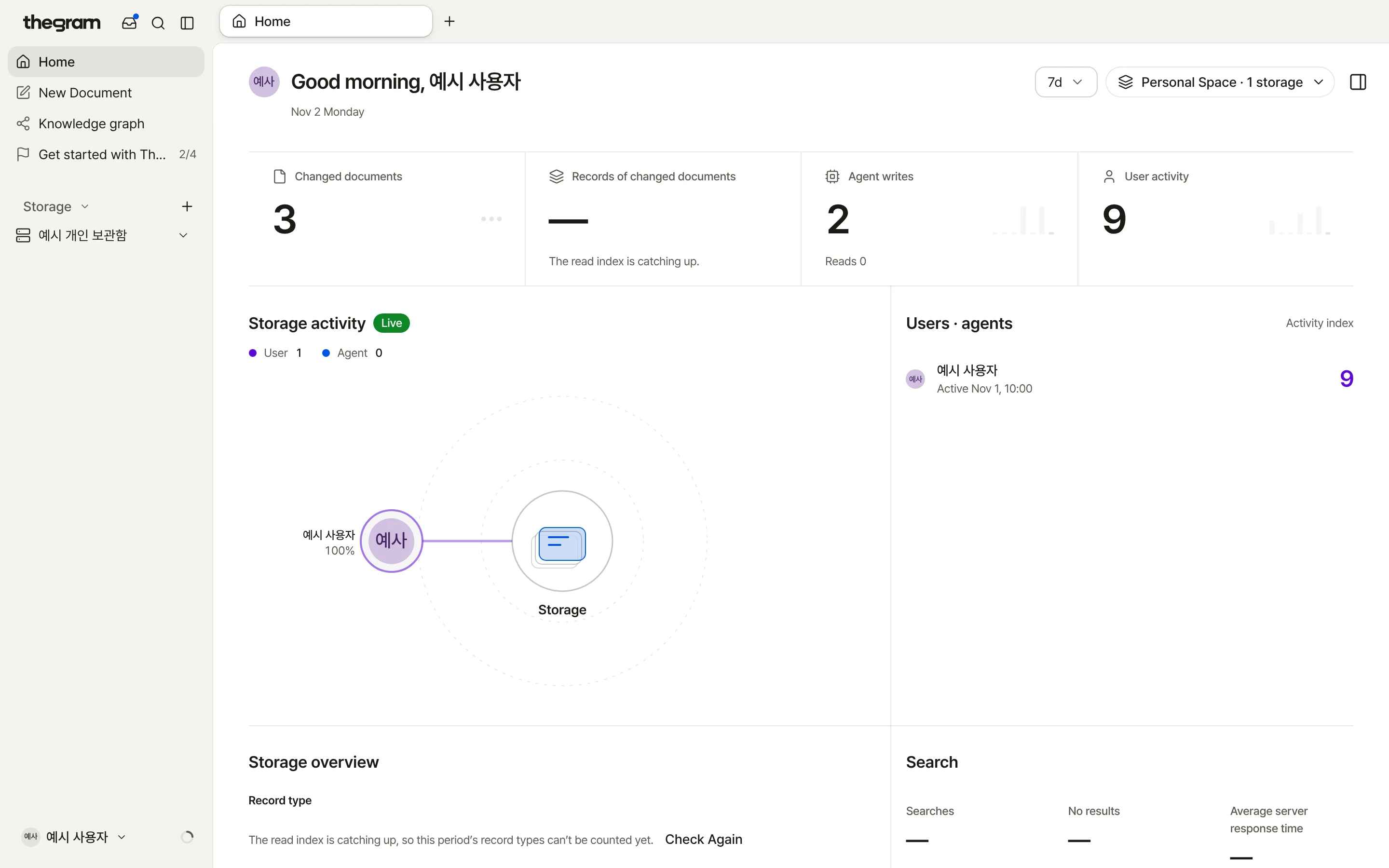
Select **Home** in the left menu. It shows in numbers what happened in your storages during the chosen period.
Home. Choose the period and the scope at the top right.
| What you see | Meaning |
| --- | --- |
| **Changed documents** | Documents created or edited during the period |
| **Agent writes** | How many times a connected AI wrote to a storage. Check here whether your AI is saving |
| **User activity** | Actions by people |
| **Storage activity** | A diagram of who (users, agents) worked in which storage |
| **Storage overview** | How much there is by record type and by file format |
Change the **period** (1 day, 7 days and so on) and the **scope** (space and storages) at the top right.
## Inbox {#inbox}
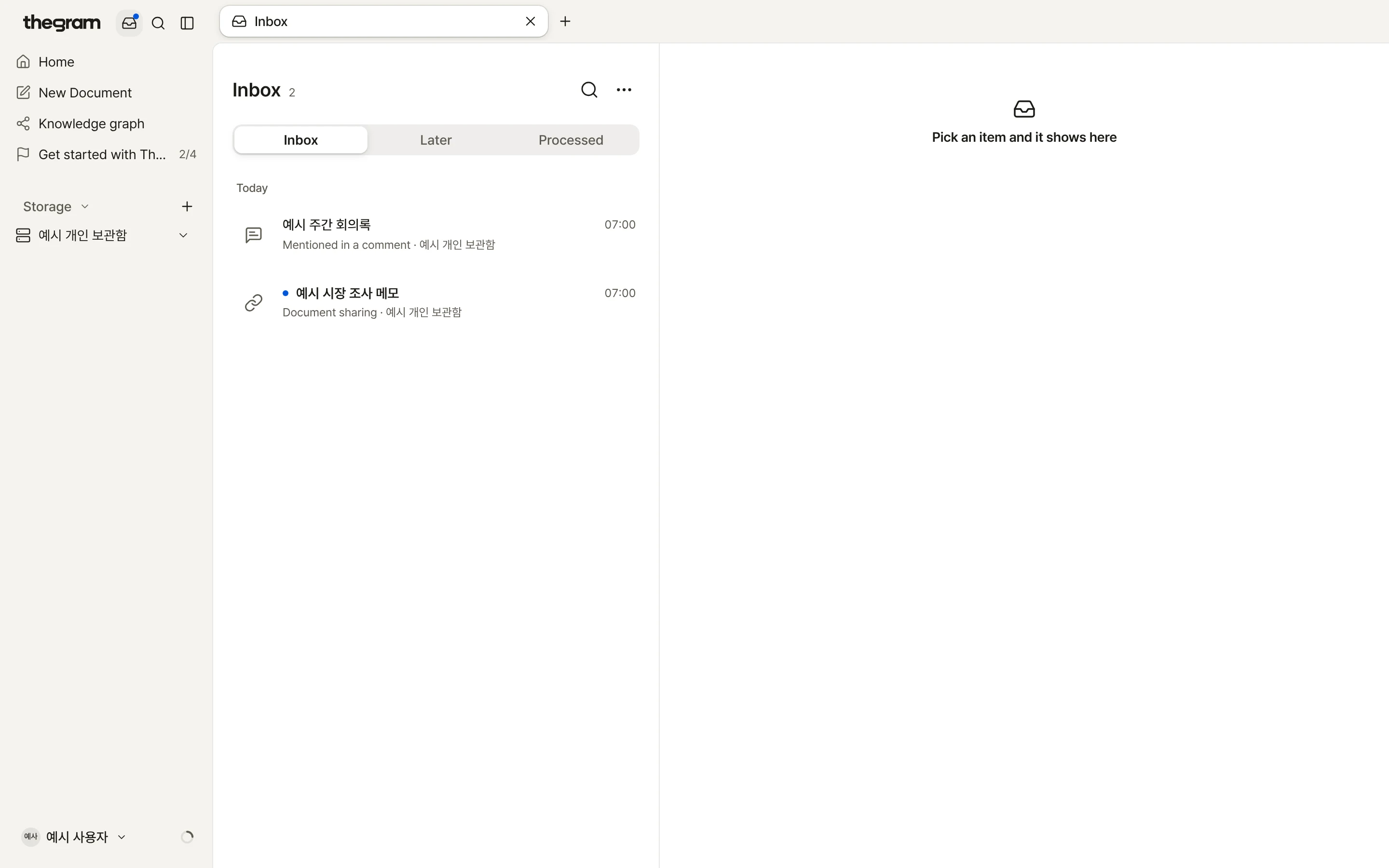
Select the inbox icon at the top left. A dot on the icon means something is unread.
The Inbox. Select an item to open it on the right.
What arrives here:
- **Mentioned in a comment**: someone called you with `@` in a comment.
- **Document sharing**: someone shared a document with you.
Items are sorted into three tabs. **Inbox** holds new items, **Later** what you put off, and **Processed** what you finished.
## Knowledge graph {#graph}
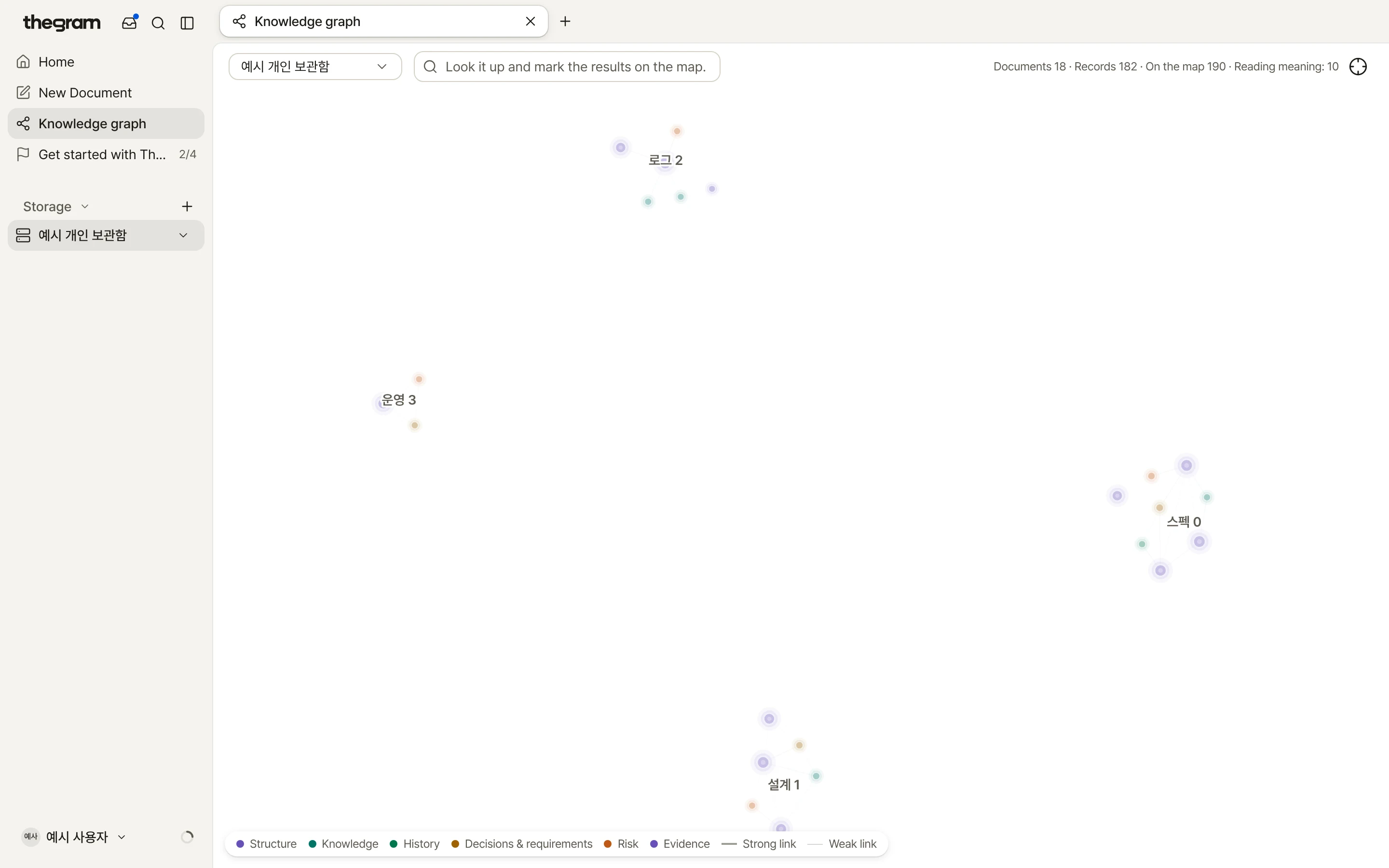
Select **Knowledge graph** in the left menu or on a storage screen. Documents and records are dots, and the relations between them are lines.
Dots that sit close together are documents and records that are connected.
- Choose the **storage** at the top left.
- Type a word in the search field next to it to mark the matching dots on the map.
- Drag to move and use the mouse wheel to zoom.
- The legend at the bottom gives the kind of each dot (Structure, Knowledge, History, Decisions & requirements, Risk, Evidence). A thick line is a strong link, a thin line a weak one.
The knowledge graph is good for questions like "which evidence does this decision rest on?" and "how many documents have gathered on this topic?". To find a specific piece of content, [search](/use/search/) is faster.
## Account menu {#account-menu}
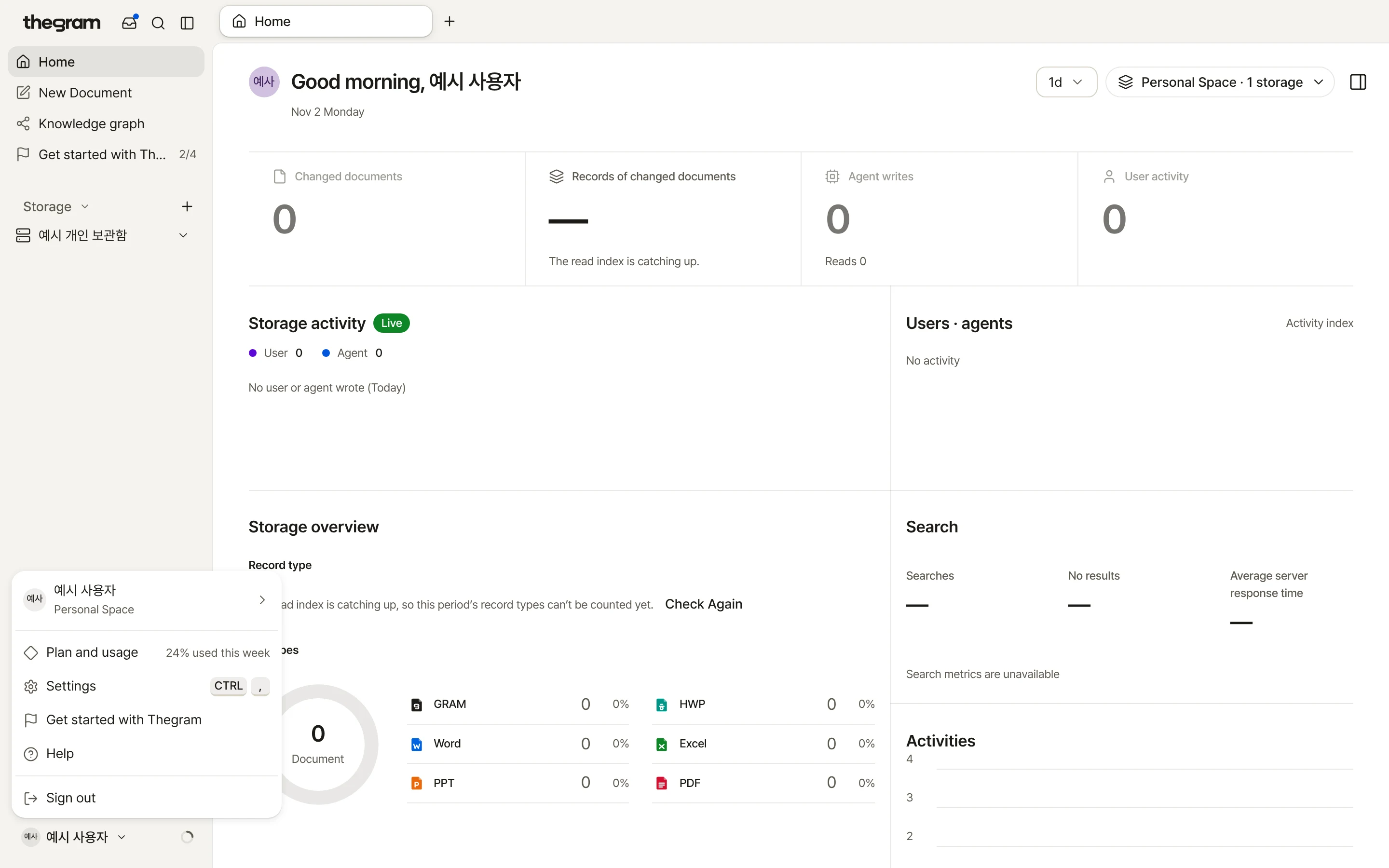
The menu that opens from your name at the bottom left.
The account menu.
| Menu | What it does |
| --- | --- |
| Your name and space at the top | Switches between your personal space and organizations. You also create a new organization here |
| Plan and usage | Shows how much you used this week. [Plan and usage](/manage/plan/) |
| Settings | Opens Settings (Ctrl+,) |
| Get started with Thegram | Reopens the [start guide](/start/) |
| Help | Has the guide, keyboard shortcuts and problem reports |
## If you are stuck {#help}
- **A number on Home shows "—".** The counts are still catching up. Look again in a moment.
- **The knowledge graph is empty.** The chosen storage has no documents, or another storage is selected. Change the storage at the top left.
Next chapter: [Share storages and documents](/team/sharing/)